Benchmark
How Spine (spinekit) compares to other Python agent frameworks on objective,
reproducible metrics. No hand-waving: every number here was measured with the
script in scripts/benchmark.sh,
and you can re-run it yourself.
What this is — and isn't
This measures footprint (dependencies, install size) and code to accomplish a task — the things that affect your project's weight and ergonomics. It does not measure model quality or end-to-end latency: those are dominated by the LLM, not the framework, and aren't a fair framework comparison.
Methodology
- Date: 2026-06-19 · OS: macOS (arm64) · Python: 3.13 · installer:
uv. - Each framework installed fresh in its own empty virtualenv with its base
package (no extras), then measured for transitive dependency count and
on-disk size of
site-packages. - Versions pinned to whatever was current that day (listed below).
- Reproduce:
bash scripts/benchmark.sh.
Footprint — dependencies & install size
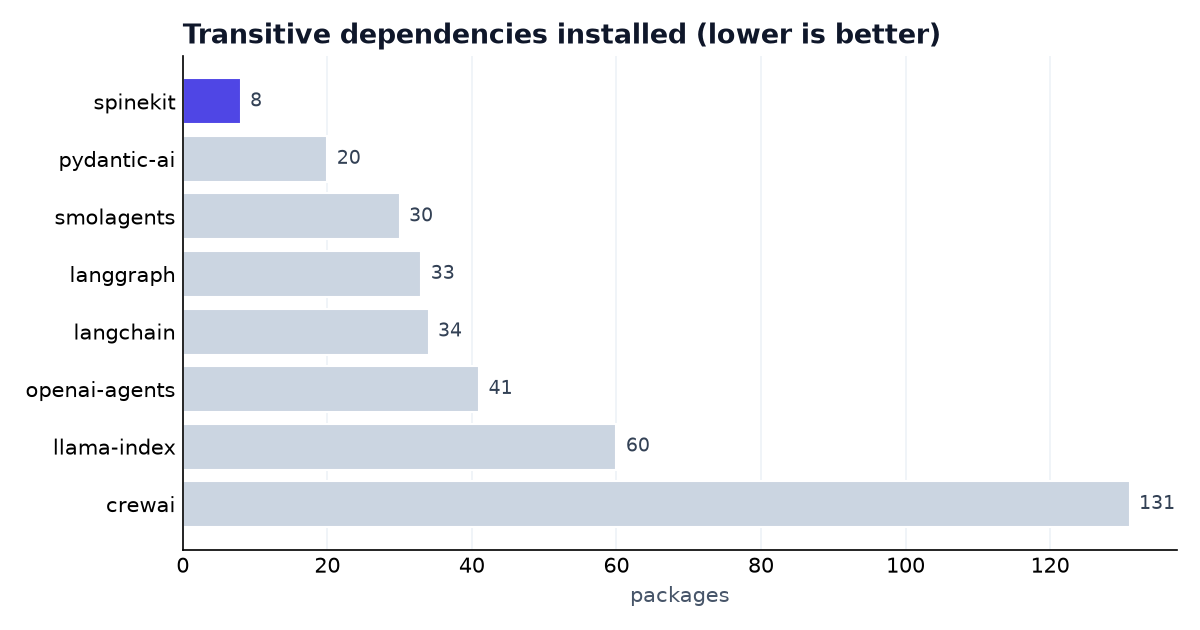
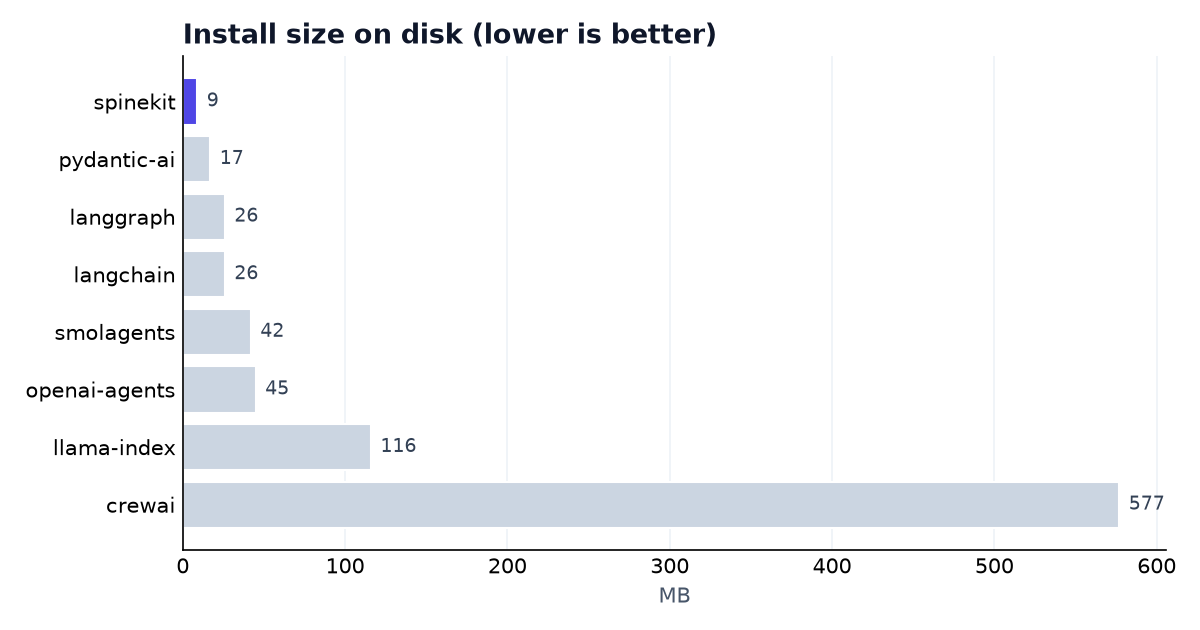
The base install is what every user of your project pays for. Spine's kernel depends on only Pydantic + anyio.
| Framework | Version | Packages | Install size |
|---|---|---|---|
| spinekit | 0.2.0 | 8 | 9 MB |
| pydantic-ai (slim) | 1.107.0 | 20 | 17 MB |
| smolagents | 1.26.0 | 30 | 42 MB |
| langgraph | 1.2.6 | 33 | 26 MB |
| langchain | 1.3.10 | 34 | 26 MB |
| openai-agents | 0.17.5 | 41 | 45 MB |
| llama-index-core | 0.14.22 | 60 | 116 MB |
| crewai | 1.14.7 | 131 | 577 MB |
spinekit installs the fewest packages and the smallest footprint of the set —
~2.5× fewer deps than the next lightest, and ~16–65× smaller than the heaviest.
Heavy provider/vector/telemetry deps are opt-in extras (spinekit[openai], …),
so they only land in your project when you ask for them.
Lines of code to a working tool-using agent
Spine's minimal "agent that can call a tool" — executed, this is the whole program:
from spine_core import Agent, tool

@tool
async def add(a: int, b: int) -> int:
    """Add two numbers."""
    return a + b

agent = Agent("openai:gpt-4o-mini", tools=[add])
print((await agent.run("add 2 and 2")).answer)
6 source lines (excluding the docstring). The same three lines get you a bare agent:
from spine_core import Agent
agent = Agent("openai:gpt-4o-mini")
print((await agent.run("hello")).answer)
On cross-framework LOC
A minimal tool-agent in pydantic-ai / smolagents is similarly small;
langchain, langgraph, and crewai typically need more wiring (graph
nodes, crews/tasks, or executor setup). Exact counts depend on the API
surface you use, so we publish Spine's verified numbers and leave precise
cross-framework counts to the linked, runnable examples rather than asserting
figures we didn't execute.
What ships in the box (no extra install)
The kernel does more in its small footprint than most frameworks do at all:
| Capability | spinekit | Notes |
|---|---|---|
| Guards (steps/cost/tokens/time) enforced in the kernel | ✅ built-in | structural, every step |
No hidden prompts (typed Message everywhere) |
✅ | |
| Durable HITL interrupt/resume across restart | ✅ built-in | |
| Deterministic record/replay | ✅ middleware | |
| Streaming (tokens + step events) | ✅ | |
| Checkpoint backends (SQLite/Redis/Postgres) | ✅ | extras for redis/postgres |
| Semantic memory (pluggable embedders) | ✅ | |
| MCP tools · A2A agents · OpenTelemetry | ✅ adapters | |
| Eval harness (Cost/Latency/Efficacy/Reliability) | ✅ | |
| Multi-agent (sequential/supervisor/handoff) | ✅ | |
mypy --strict clean, typed at every boundary |
✅ |
(Feature availability in other frameworks varies by version and add-ons — verify against their docs; this column states only what Spine ships.)
Spine internals
Measured on this repo:
- Kernel loop (
agent.py): 540 lines. spine_coretotal: ~1,700 lines, 2 runtime dependencies.- 135 tests, all of ruff +
mypy --strictclean in CI.
Caveats
- Footprint depends on the platform and resolver date; re-run the script for your environment.
- "Base install" excludes extras; a fair head-to-head adds the provider SDK both
sides need (e.g.
spinekit[openai]≈ +1 dependency:openai). - We deliberately omit import-time and runtime-latency numbers: modern frameworks lazy-load top-level imports (making import time non-comparable), and latency is the model's, not the framework's.